

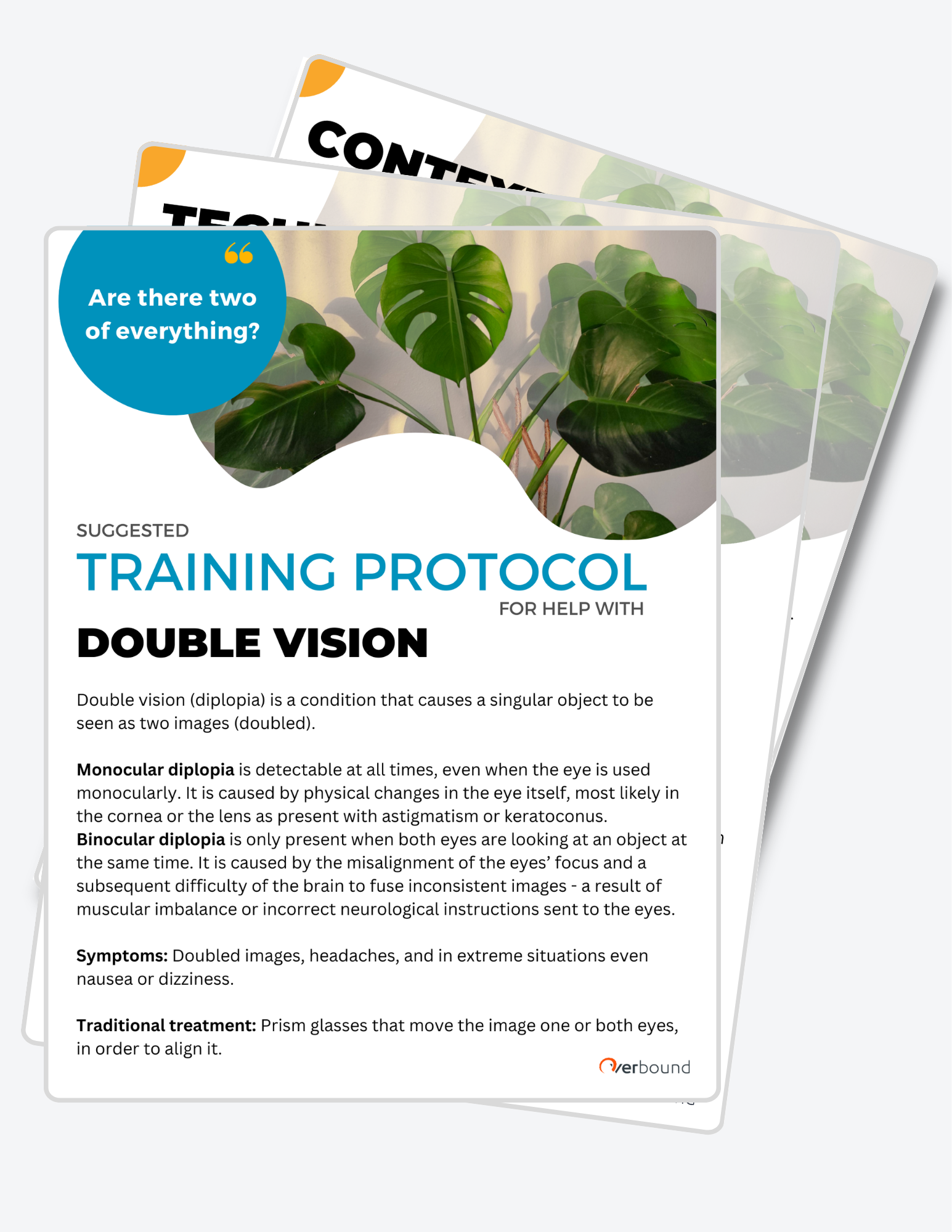
Double vision (diplopia) is a condition that causes a singular object to be seen as two images (doubled).
There are two basic types of diplopia: monocular diplopia, which is detectable when the eye is used monocularly (one looks, one is covered), and binocular diplopia, which is only present when both eyes are looking at an object at the same time.
Monocular diplopia is caused by physical changes in the eye itself, most likely in the cornea or the lens. Astigmatism is an example of monocular double vision.
Binocular diplopia is caused by the misalignment of the eyes’ focus (a result of muscular imbalance or incorrect neurological instructions sent from the brain to the eyes) and a subsequent difficulty of the brain to fuse inconsistent images it receives. The focus of this lesson is on binocular diplopia.
Symptoms: Doubled images, headaches, and in extreme situations even nausea or dizziness.
Traditional treatment: Prism glasses
Natural correction: The path to see objects as singular awaits you inside this month’s lesson.
May your eyesight be boundless.
Irena
TOUCH OF ANATOMY
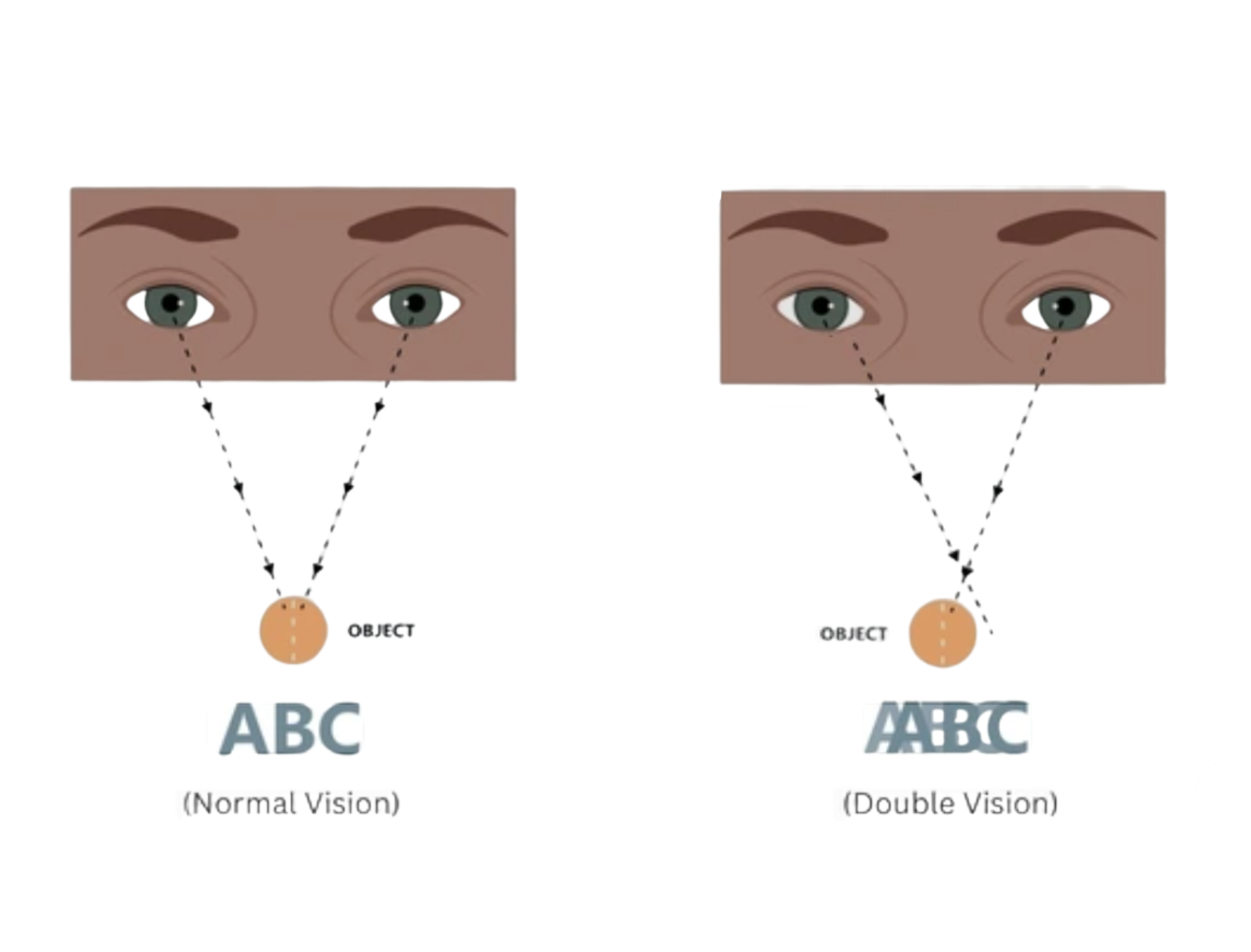
When looking with both eyes the brain receives two images. In order to deliver a good singular image, the two separate images must be of the exact same target. Only then can the brain combine them in a way that gives the person a perception of a singular image. The process of combining the images is called fusion. Here is, in short, how fusion works:
Fusion begins in the visual cortex.
The neurons in the brain receive input from both eyes simultaneously. They compare the position of objects in the image, their orientation, the contrast, obvious edges, etc.
The images don’t have to be absolutely perfect, but they have to be close enough. If the two images fall within a small positional tolerance called Panum’s fusional area, they are fused. If the difference exceeds this zone, the person experiences double vision.
MANTRA FOR SEEING SINGULAR IMAGES
“My two eyes always look at the exact same spot and all objects I see appear singular, with sharp edges.”
Directions for using the mantra as part of your routine:
Repeat at least 5 times before beginning your practice. Best when said aloud, with your eyes closed, visualizing seeing far objects and feeling the joy of seeing them. Whatever “far objects” means for you is your choice. Remember that you are the master of your mind. You control the mind, which controls your brain, which then controls your body (per neuroscience and neuropsychology). Choose the way you want to see, then through your thoughts (by making clear, positive, non-negotiable statements about your desired future, but in the present tense) command your brain to help you while you take action in the form of your daily practice.
RESOURCES & LESSON
Remember to adjust the playback speed of any Overbound videos to fit your liking. Click on the gear icon and make your speed selection. This is especially helpful for repeat viewing.
RELATED LINKS
The Swings (incl. head and optical swing)
Seeing two strings and a cross (Brock String technique)
New lessons are added to Boundless Eyesight on a monthly basis. Check the current list of lessons for additional resources, especially if lots of time has passed since this lesson was published.
FOCUSED Q&A REPLAY
Remember to adjust the playback speed of any Overbound videos to fit your liking. Click on the gear icon and make your speed selection. This is especially helpful for repeat viewing.