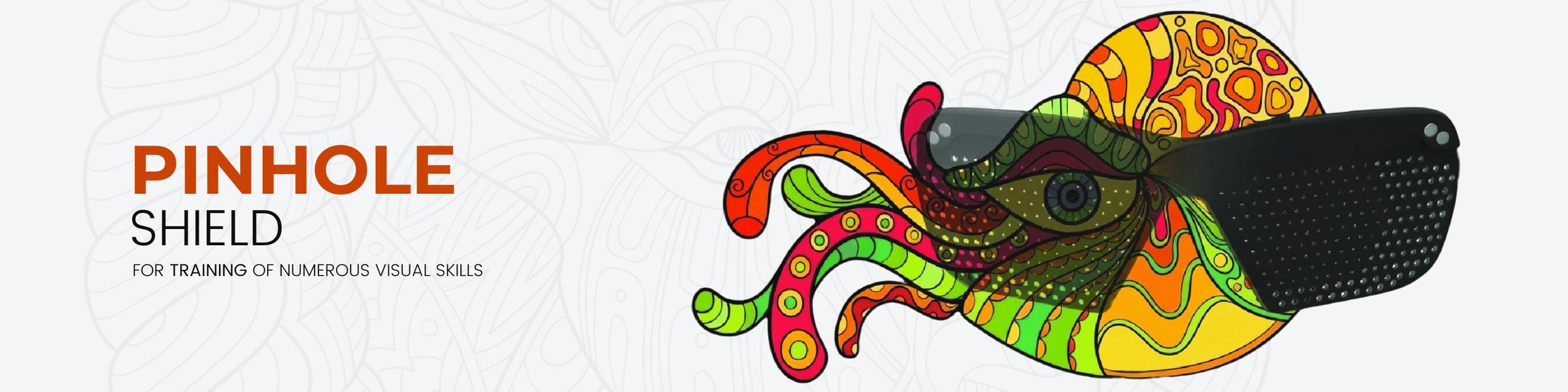
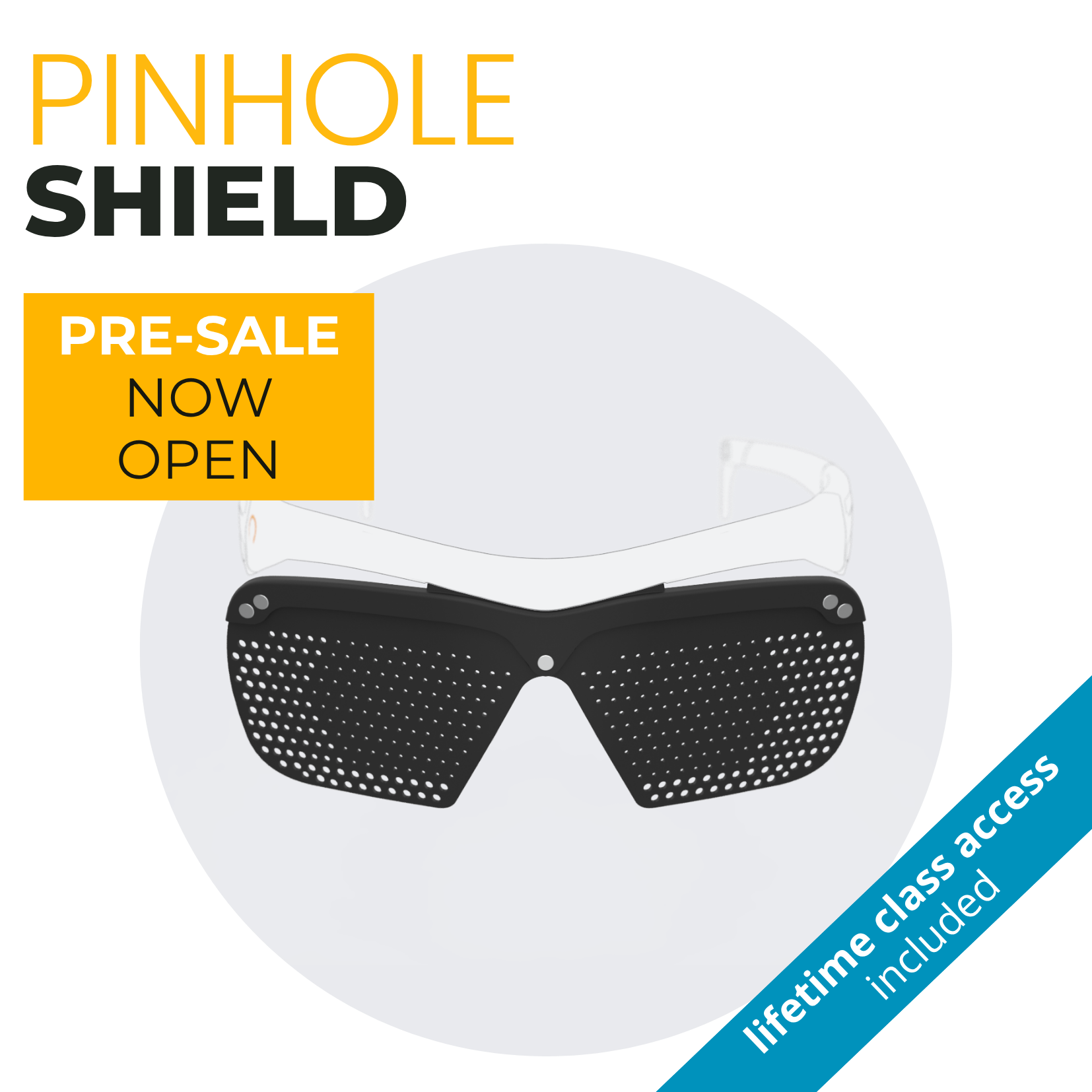
Overbound pinhole shield is a uniquely designed tool that significantly elevates the attributes and therefore usability and effectiveness of traditional pinhole glasses. It introduces functional features that support the training of numerous eyesight skills not in visual silo, but in the context of visual surroundings. In three distinct zones It brings various levels of light penetration and elevated control of the direction in which light rays enter the eye. All of this offers the wearer a sharper image and easier learning.
WHAT IS A PINHOLE SHIELD AND WHAT CAN IT DO FOR ONE’S VISION?
Pinhole glasses are eyewear made with an opaque (usually black) shield perforated with many small holes. They work by leveraging the mechanism called small aperture or stenopeic (pinhole) effect.
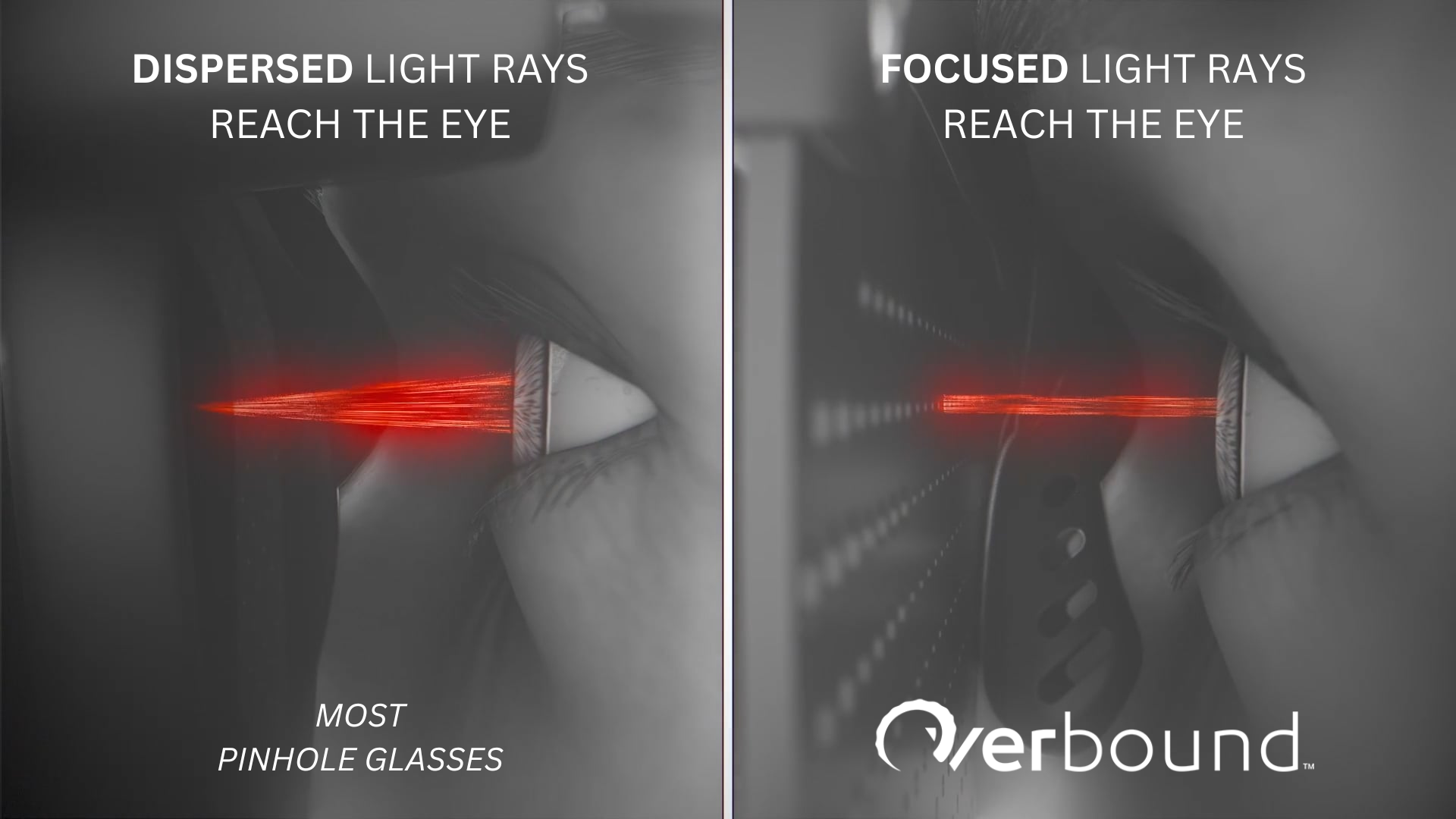
Each small hole allows only a narrow bundle of light rays to enter the eye. By limiting how much scattered light gets in and what direction the light travels through the pinhole shield, the glasses reduce blur and help the eye form a sharper image. In other words, the shield tames the light as it enters each hole and sends it towards the eye in a less distracting, more focused manner. By reducing the amount of blur reaching the retina, the glasses make objects be seen with better clarity, especially for people with common focusing issues like nearsightedness, farsightedness, presbyopia, or even astigmatism.
DO PINHOLE SHIELDS REALLY WORK?
Yes, they do. For some people, the simple fact of wearing them leads to improved vision. Others need to use them for more intentional training. Whatever group you fall into, they will help you with the development of many visual skills that are essential for good seeing.
Before we get technical though, what pinhole glasses do for nearly every person is to give them hope.
“People realize that their eyeballs are not “broken” so to speak, that they can retrain them.”
THE UNMATCHED ADVANTAGE OF THE OVERBOUND PINHOLE SHIELD
Not all pinhole glasses are created equal. In fact, most pinhole glasses that have been here for decades present many flaws that diminish their functionality and therefore results for their users.
Overbound Pinhole Shield is unique in many ways.
Click on the video below and see for yourself. On the left side are common pinhole Glasses. On the right is the new Overbound Pinhole Shield.
Explore the unique features of the Overbound Pinhole Shield and learn why they matter
Straight holes
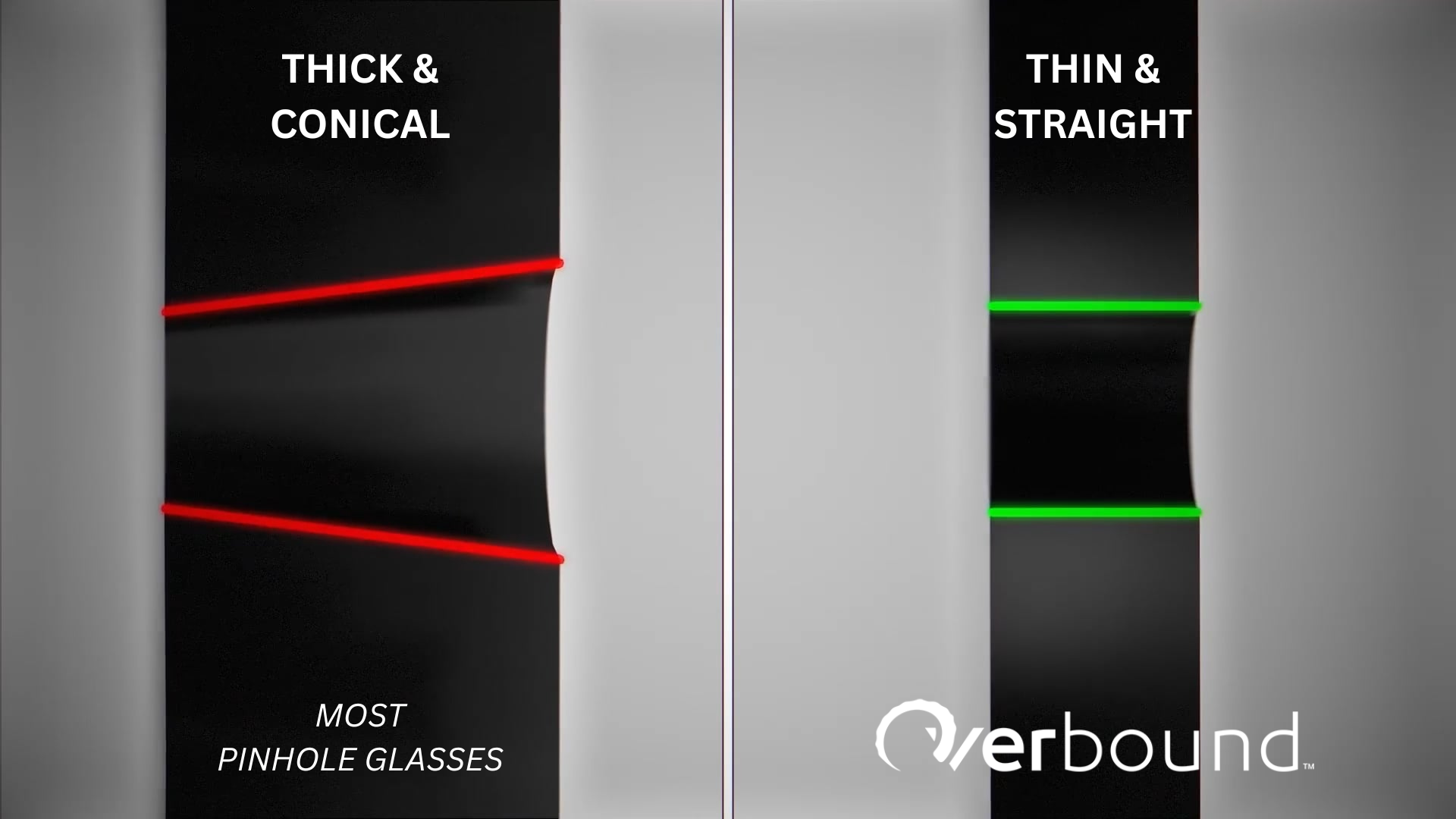
One of the biggest downfalls of most pinhole glasses is the conical shape of the holes where the larger opening is facing the eye. When this happens, the light, that has been intentionally tamed by the outer small hole, begins to disperse again before hitting the eye. It increases the blur and decreases the depth and clarity of the regarded object. In other words, it significantly diminishes the effectiveness of the pinhole effect.
Overbound Pinhole Glasses are made with straight holes, ensuring that the light that comes through does not easily change directions.
Minimized grid visibility
If you have used traditional pinhole glasses, you might have experienced seeing the grid between the pinholes. It may look something like a reversed honeycomb, but it may have a different shape as well. The two main contributors to seeing the grid are the thickness of the lens (the thicker the lens, the more prominent the grid), and the distance in between the holes.
Overbound Pinhole Shield is made of a very thin aluminum shield measuring only 1 mm in thickness. Additionally the hole-spacing has been optimized to minimize the grid effect while delivering top notch visual properties.
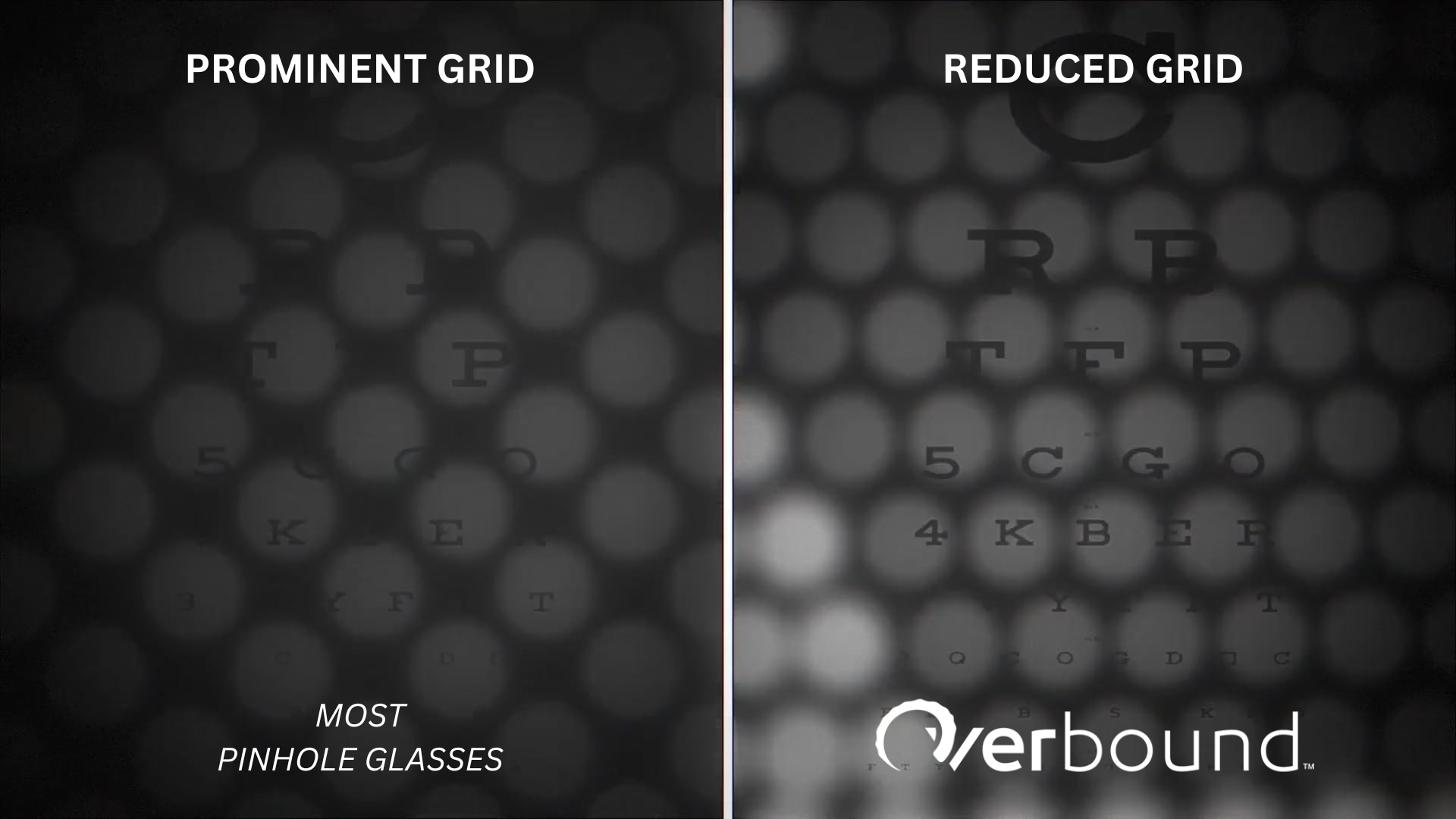
Three pinhole zones provide for ideal learning environment
Zone 1 - Central zone with small holes - designed for acuity training
Zone 2 - near-mid peripheral zone with medium size holes for visual context
Zone 3 - Far peripheral zone with large holes for spatial awareness and a seamless visual transition
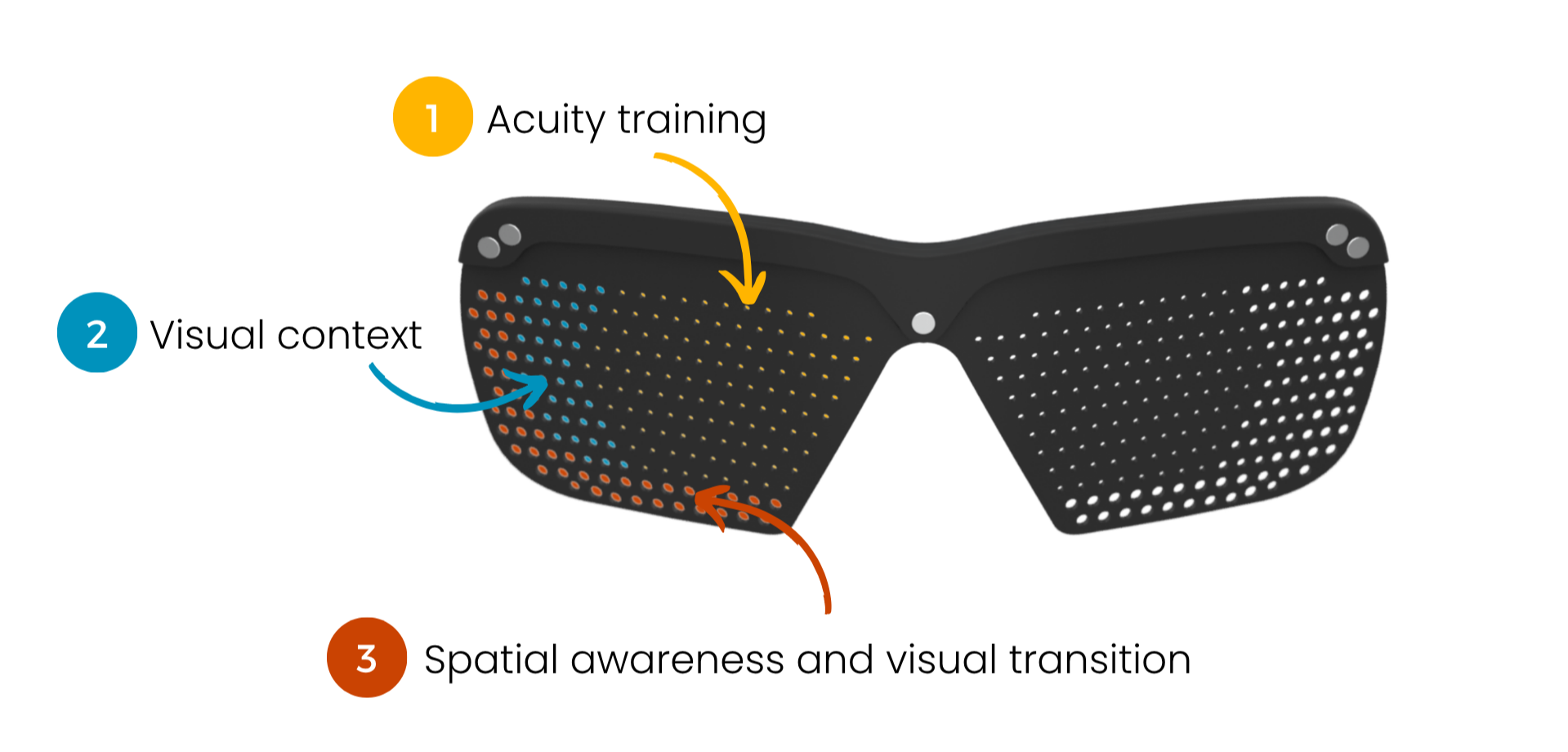
Hole size ideal for increased visual clarity at near and far
Big holes? Small holes? Finding the right hole size that brings the best possible clarity to most eyes and that serves the needs of looking near and looking far is of an utmost challenge. We tested our glasses with students who are farsighted and nearsighted, with students who have experienced presbyopia and those with astigmatism. After many rounds of adjustments, we hear that the holes are just right.
Not one, but three.
In addition to the central hole, the Overbound pinhole glasses offer two more hole sizes, one in each pinhole zone. While it is most common to simply wear the glasses and look through the center holes, our pinhole shield is removable from the frame, so you can use any hole size you like during your active practice.
This feature also serves as a fantastic way to progressively bring your improved visual skills from the controlled environment provided by the small holes to the real world (no pinholes).
Frameless design for natural integration with one’s surroundings
There is no boundary, no hard edge for your vision field behind the Overbound Pinhole Shield pinhole glasses. While your training will likely focus on the development of central visual skills, your peripheral vision will be there to support you in the task.
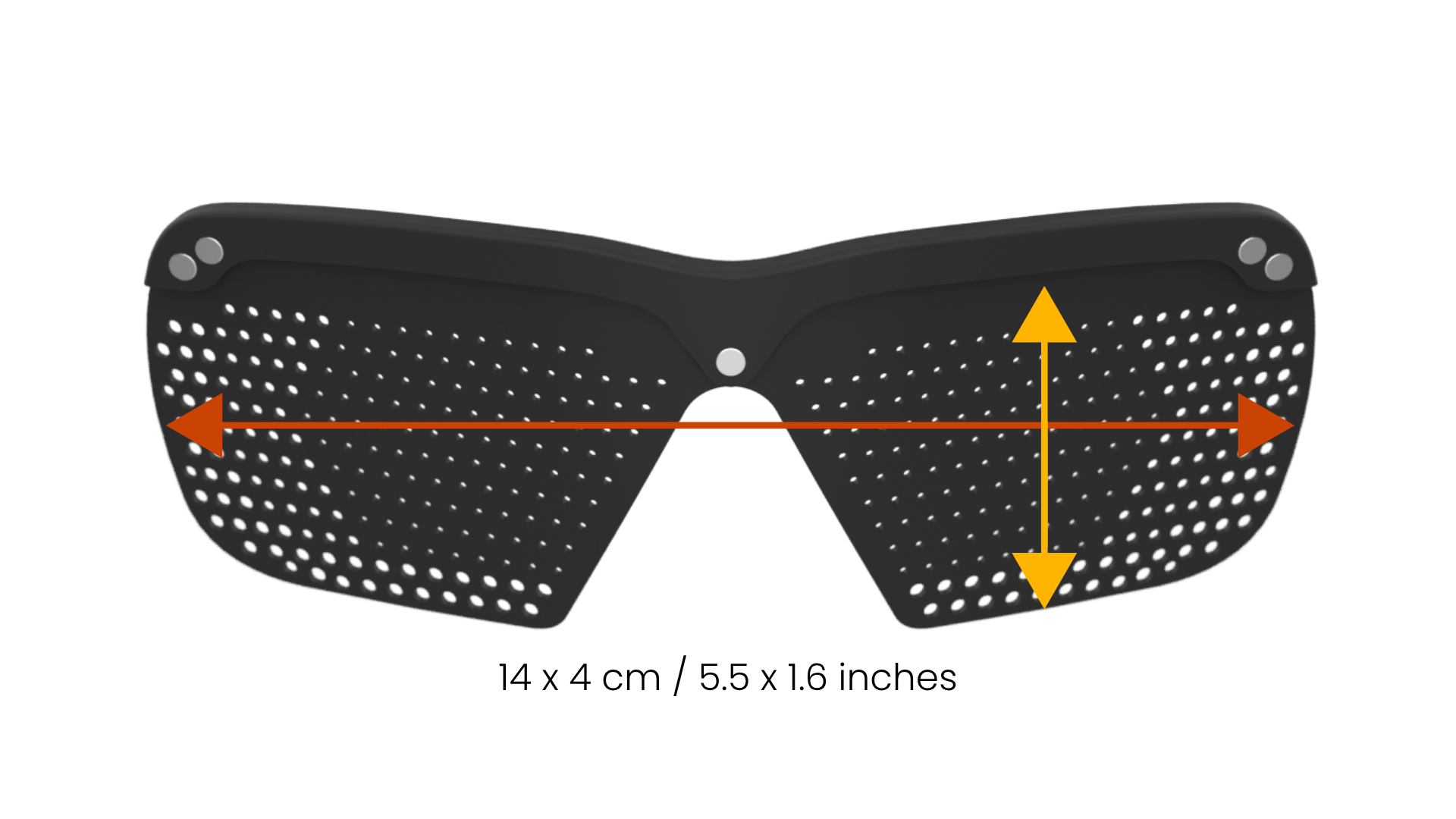
The eyes must move. They need movement in order to function well and to deliver clear seeing. Even in their pursuit of learning new skills, they should never be limited more than necessary. The Overbound Pinhole shield measures 14 x 4 cm (5.5 × 1.6 inches) and thus provides more vision training space and coverage than most - if not all - other pinhole glasses. So look wherever your attention drives you, we have you covered!
Large surface for easy training
Matte velvety finish limits distracting light reflection
Most pinhole glasses are made of shiny plastic. When worn, the light can bounce as it passes through the holes and can reflect off of the surface of the glasses, increasing the number of directions from which light rays come into the eyes. The Overbound pinhole glasses are anodized and look and feel as if coated with soft velvet. No light reflection. No glare. Pure focus.
LOOKED AT FROM ALL ANGLES
Designed with insights and input from the most prominent experts in the vision improvement field
This shield is the result of cooperation with the top experts in vision improvement. Before beginning to develop this tool, Irena Castle - the innovator behind the Overbound Eyesight Training system and the person who brought the Pinhole Shield to life - interviewed the most prominent personas in the vision improvement field around the globe, searching for their observations about and issues with regular pinhole glasses. Out of these interviews came a check list of desires for improved functionality. More than three years later all the boxes were checked and the requested attributes are now being introduced to you in the form of the Overbound Pinhole Shield.
“My deepest thanks go to our advisors for their invaluable input that made this tool the best it can be. I am grateful for your wisdom.”
Our advisors
Dr. Ainhoa de Frederico - Research Professor, Director of the International Center for Vision Coaching at UIDHL, author, speaker, and the founder of the Clear Sight Method
Dr. Ray Gottlieb, OD - a life long holistic ophthalmologist who has connected the world of medical eye care with the eye-brain approach of the Bates Method and other modalities. Author of many worldwide distributed techniques and materials for vision training.
Kevin Wooding - a music artist, Alexander Method teacher, a vision improvement teacher, and the force behind seeing.org
Lizzie May - a phenomenal teacher and co-owner of Bates Method International
Nathan Oxenfeld - President of the American Association of Vision Educators, podcast host, author, and the founder of Integral Eyesight
WHAT CONDITIONS CAN THIS PINHOLE SHIELD HELP WITH?
Overbound pinhole glasses help with acuity training regardless of visual condition. They deliver images in high clarity for near and far distances.
They can also help with activation of visual receptors in underused or damaged vision areas and with redirection of undesired use of fixation (i.e. excentric fixation). With a slight adaptation they may contribute to an improvement of proper focusing, which is necessary for good binocular and 3D vision. Therefore, they are a great choice for anyone who is experiencing:
MYOPIA | PRESBYOPIA | HYPEROPIA | ASTIGMATISM | CHOROIDAL RUPTURE | MACULAR PUCKER | EYES WITH MISSING PARTS OF VISION | EYES WITH UNUSUAL FIXATION, SUCH AS STRABISMUS
USING THE OVERBOUND PINHOLE SHIELD
You can wear pinhole glasses in safe situations like reading, watching TV, or doing light house work in order to see more clearly while wearing them. In those situations they may replace your prescription glasses for short periods of time, like 15, 30 or even 60 minutes.
However, vision improvement in the sense of a positive change in the natural functions of the eyes (seeing better without devices), will happen more reliably and much faster if you also use the pinhole glasses as a training device. The absence of knowing how to use pinhole glasses and the lack of short but active practice, is the reason why many people say that pinhole glasses do not improve vision.
Think about it this way. Pinhole glasses create an ideal scenario - clear image at the distance where vision with no devices is usually blurry. They provide desired visual input to the brain teaching it how to interpret such visual signals. Given the brain is responsible for the vast majority of the seeing process, it has the ability to change the way it understands the visual signals. Over time it may learn to see the visual input coming from that distance clearly even without the pinhole glasses. To do this right, understanding and practice of several specific skill building techniques is needed.
Safety first!
Please know that pinhole glasses are a specialty occluder. While the Overbound pinhole glasses offer a greatly improved peripheral inclusion and low grid visibility, there are still areas of the vision field that may be difficult to see. Therefore, they should only be used in safe situations, never for driving, while using sharp knives or in any other situations where perfect vision is required.
GET THE OVERBOUND PINHOLE SHIELD NOW
What’s in the box?
One (1) Pinhole Shield featuring:
Straight holes
Minimized grid effect
Three hole sizes in three zones
Frameless design
Large pinhole surface
Velvety matte finish
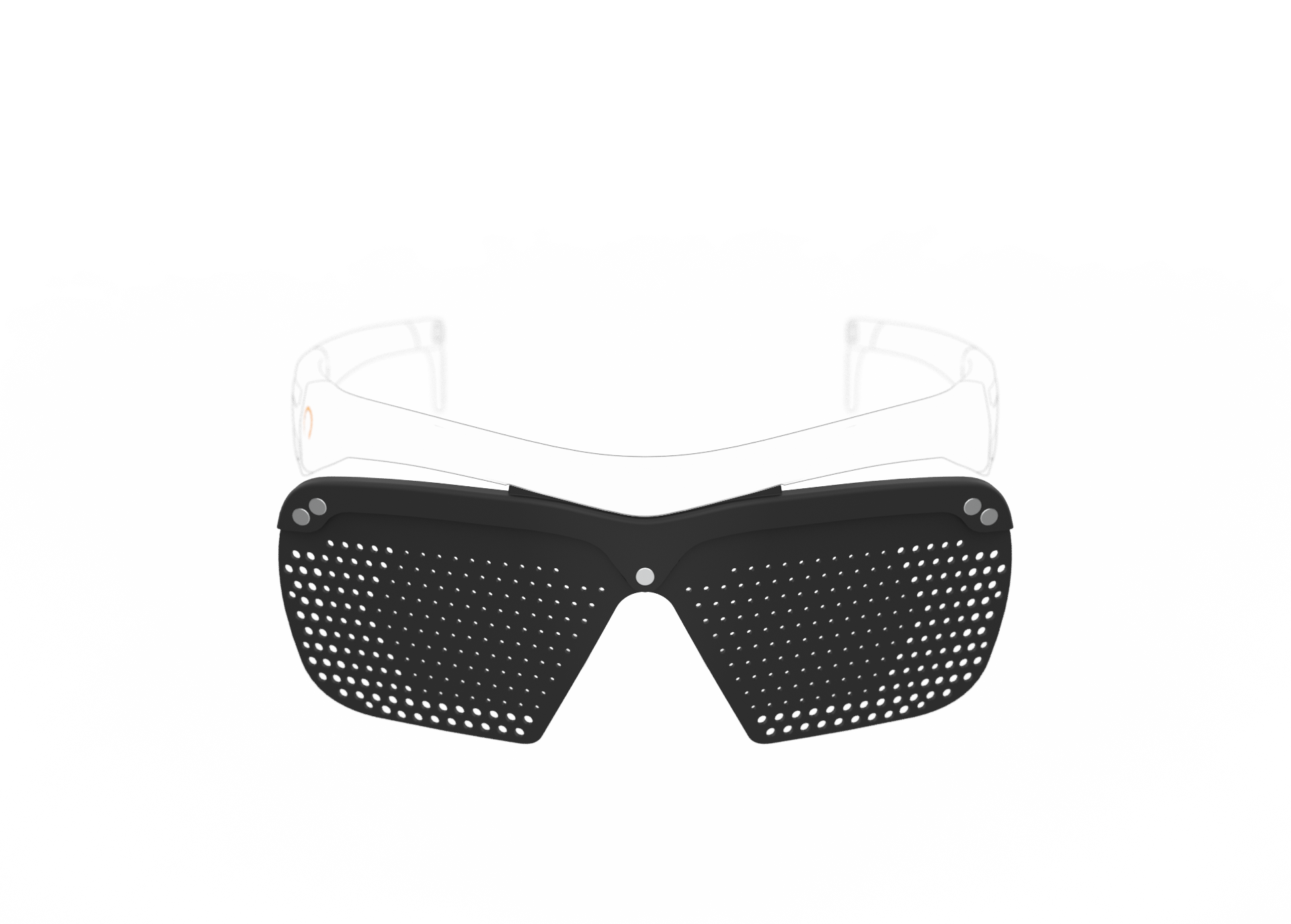
The shield attaches seamlessly into the Overbound Eyesight Trainer frame* and can be stored inside the case.
*The frame is not included. It is available as part of any Overbound kit
BEC launch deal
As a thank you for being among our most loyal clients please accept two BEC special deals:
20% off the new Pinhole Shield, and a lifetime access to a class “Introduction to Training with Pinhole Glasses”
Free Gift in the form of a Large Case that can house the frame of the Overbound Eyesight Trainer, as well as all your training attachments (incl. the new Pinhole Shield)
Other Overbound tools are on a pre-sale special and available to BEC and to the general public.
All deals end on Sunday, August 9, 2026. See store details.

The Nautilus
At Overbound we tap into the animal kingdom to demonstrate the immense capabilities of our products and to present them in a somewhat aspirational fashion. The Overbound Pinhole Shield packaging is no exception as it features the only animal on the planet with truly pinhole vision. That animal is the chambered nautilus.
The chambered nautilus (Nautilus pompilius) is one of the oldest living animals on Earth, belonging to a lineage that has survived for more than 500 million years. Often called a "living fossil," it inhabits the deep slopes of coral reefs throughout the tropical Indo-Pacific, where it spends its days hundreds of meters below the surface and rises closer to the reef at night to feed. Its iconic spiral shell is divided into a series of chambers that allow it to regulate its buoyancy, enabling it to drift effortlessly through the water.
The chambered nautilus is unique in the animal kingdom because it is the only known animal with true pinhole eyes. Unlike the lens-based eyes found in humans, fish, and birds, the nautilus eye contains no lens at all. Instead, light enters through a tiny opening, much like the aperture of a pinhole camera, and projects an image directly onto the retina. This design produces an image that, while likely dim and lacking detail, is always in focus because only a small amount of light reaches the eye. Through its extraordinary visual system nautilus demonstrates that effective vision can be achieved through remarkably simple anatomy.